Drawing the Circle Mark Batterson
The post-obit is a review of The Circumvolve-Maker by Marking Batterson published in 2011.
Table of Contents
→ Concern #1 – Sacred Symbol
→ Concern #two – 'Me' at the Eye
→ Concern #three – Prescriptive Praying
→ Concern #4 – Invoking Deity
→ Conclusion
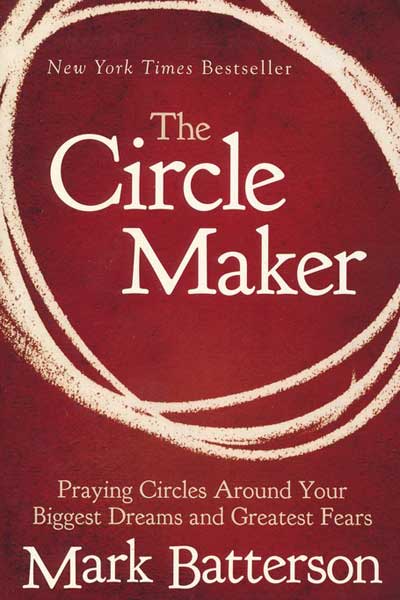
The Circle-Maker introduces us to the legend of Honi the circumvolve-maker. Honi drew a ritualistic circle around himself in the sand wherein he prayed that God would cascade forth rain. According to the author, Honi prayed with "the authority of the prophet Elijah" (p. 10). The rain came (or then they say).
Honi'due south full name is Honi ha-M'agel and his tomb is in Hatzor HaGlilit, Galilee. Though Honi is referred to in the ancient Jewish writings (Talmud, Midrash) and likewise by Josephus, he is not found in the Onetime Attestation Scriptures.
One might remember this is only a nice little inconsequential legend we tin read near and move on. Merely Batterson informs his readers that they should "imitate" Honi's method of drawing prayer circles. He writes, "The earth has circled the sun more than ii thousand times since the day Honi drew his circle in the sand, but God is still looking for circle makers" (p. 13). The question then becomes: Should Christians imitate this exercise?
Some would say an emphatic yes! Popular leaders such equally Nancy DeMoss Wolgemuth encouraged circle-making at her True Adult female Briefing in 2012 too as in 2014 on her Seeking Him podcast episode titled Within This Circumvolve. Jen Hatmaker has promoted it on her website likewise. Also, John Ortberg, pastor of Menlo Park Presbyterian Church, said, "Honi the circle-maker is a long-fourth dimension legendary figure, and Mark Batterson is well on his manner. You will love the freshness of this approach to prayer."
This is where we take a problem. A large problem.
God has never mentioned in Scripture that prayer should include drawing circles, rather figurative or literal, around ourselves or anyone else! Why would leaders within Christendom be promoting something drawn from legend? It causes great confusion for God's people.
Permit me explain several concerns most the teachings found in "The Circle-Maker."
Concern # one – Sacred Symbol
Batterson writes that Honi's circle, which he drew in the sand and of which he was in the center and prayed – became a sacred symbol. (p. 11) Did yous grab that? A story and its practice – not plant in the Bible – is a sacred symbol for Christians?!
The practice of circle-making is actually establish in pagan religions and witchcraft (as some have pointed out). Information technology was most recently introduced into the church through gypsy civilisation. Information technology is reported that there was a famous gypsy revivalist from the late 19th and early on 20th century, named Rodney 'Gipsy' Smith, who used circle-making. The practice of integrating the "gypsy circle of protection" into Christianity is widely attributed to Smith.
An bodily sacred symbol is something that represents a spiritual revelatory truth from God. For case, baptism represents our beingness united with Christ in His decease, burying, and resurrection. Communion represents Christ giving His life for the salvation of His people. The burning bush represents God revealing Himself to Moses and giving Him instruction. Whereas, circle-making is an image or representation of some activity done on our part that supposedly becomes a place where we meet with God. That sounds more Catholic than annihilation.
And so, why would a fable plant in infidel teachings, and non found in the Bible, ever be a sacred symbol for Christians to imitate?
Business organization # ii – 'Me' at the Middle
In that location may exist some confusion with the pic that is painted by the exercise, which is someone standing in the middle of a circumvolve and praying. Praying to the God of the Bible ways praying in His will. Batterson writes, "Drawing prayer circles starts with discerning what God wants, what God wills" (p.fourteen).
But with circle-making prayer, who is in the centre of the circle? Quite odd. If our prayers start with God, why would I draw a circle around me?
Nosotros must question whether this kind of praying truly is about God'south will beingness at the center. And, when we hear of revivals that call for prayer circles, we must wonder whose revival it is.
Concern # 3 – Prescriptive Praying
Another questionable didactics in the book is plant starting on page 13 where Batterson argues that boldness and bigness are two things God is pleased with when nosotros pray. You might be thinking information technology is good to have conviction before God in praying. Indeed, that is true.
"This is the confidence which we have earlier Him, that, if we inquire annihilation co-ordinate to His will, He hears usa. And if nosotros know that He hears us in whatever nosotros enquire, nosotros know that nosotros have the requests which we have asked from Him." i John 5:14-fifteen
But Batterson takes Biblical descriptions of God working, in an historical context with specific commands to obey, and turns them into a prescription for us to follow and claim as ours. For instance, the story of Joshua really becomes all about – us imitating Joshua (p. 15). The problem with this is that we don't receive specific promises/commands from God similar Joshua did in guild to be able to pray with "enormousness and boldness." True faith does please God. But true faith is based in God's Give-and-take. It is non birthed in united states and by u.s.a.. We practice not whip it upward in our own power.
The fruit that God brings to glorify his own name in the life of the believer is for those who abide in Christ as Christ abides in them. (John 15:vii-8) The Christian has great boldness of access into His presence because of the claret of Jesus Christ (Hebrews x:19). This boldness is based in His provision of our access to him without circles. It is non based in our ritualistic prayer circles that are centered on how we have decided He might best be glorified by doing what nosotros "boldly" desire. The picture Batterson paints goes way beyond the Biblical witness.
Concern # iv – Invoking Deity
Further, Batterson writes that "prayers are prophecies. They are the best predictors of your spiritual future." (p. fourteen) There is something incredibly deceptive with this idea. Prayers are u.s. talking to God. Prophecies are the truths God has spoken institute in the Scriptures. In God hearing us and answering us, it tin build smashing assurance in our hearts regarding His working in our lives.
But please brand no mistake about "prophecies" though. Scripturally speaking, true prophecies are God's Word. False prophecies are men and women attempting to play God and speak for God, and in this instance, the image of "praying God's words!" False prophets and prophecies are not sent past Him nor do they stand for Him.
Batterson essentially uses prayer as an attempt to invoke the deity to practise our behest and calls that faith. But if nosotros retrieve nosotros can shape our lives by what nosotros pray, how is that seeking God and His volition? At that place is a huge difference between humbly submitting to the Holy Spirit through prayer and petition according to the truths of God'south Word versus summoning God to practice our behest which we presume is His volition.
Conclusion
This is where we must finish and confess that circle-making prayer goes fashion beyond the Biblical concept. Circle-making prayer as Batterson describes it and all such prescriptive ritualistic practices of men are nowhere to be found in the Bible – except the places where we are told to abscond faux worship in the Erstwhile Testament! Drawing a circle around oneself and invoking a spirit being is found in paganism and witchcraft. Yous should admittedly run away from such pedagogy! Information technology is not of God.
Sadly, Mark Batterson has popularized the "circle-making" phenomenon which has now swept through neo-evangelicalism. Instead of rejecting it, many have embraced and do it. This is the pitiful land of the visible church building. Somehow, many retrieve we can infringe practices from paganism for a "new" Christian do and come out unscathed.
In reality, that mindset sets the stage for a continual downward spiral and is yet some other piece of "the falling away" puzzle. Unfortunately, there already are many and will be enough more false doctrines that ride in on this deceptive rug. Are yous on guard, Christian?
Source: https://www.4truthministry.org/review-the-circle-maker-by-mark-batterson/

Enregistrer un commentaire for "Drawing the Circle Mark Batterson"