Notable Works of Art Now on the Market Burlington Magazine 119
by Noti Klagka
This mail explores the scholarship on Michelangelo da Caravaggio in the pages of The Burlington Mag and reveals the crucial role played by the Magazine in the critical reception of this artist. Caravaggio has definitely been the near pop 17th century Italian artist published in the Burlington: 59 main articles and 210 shorter notes cover his work, whereas just 18 main articles are dedicated to Guido Reni, 21 to Guercino, and only 4 to Annibale Carracci.
 The Burlington manufactures are highly indicative of Caravaggio's increasing popularity in the form of the 20th century and by the beginning of the 21st century evidence the extent of the phenomenon that Richard Spear has eloquently defined as 'Caravaggiomania'. [one] The number of book reviews recently dedicated to the artist is, in fact, impressive and confirms Spear's 'mania' diagnosis: 35 new books on Caravaggio take been reviewed in the Burlington since the year 2000, a rather large number in comparing to the 10 devoted to Peter Paul Rubens.
This post focuses on the well-nigh of import articles on Caravaggio in the 2nd half of the century. Then, pioneer scholars of 17th century art – such every bit Denis Mahon, Jacob Hess, Sergio Benedetti, Luigi Salerno, Mina Gregori, Keith Christiansen, and not least the Burlington Editor himself, Benedict Nicolson – chose to publish their findings in the pages of the Magazine.
The turning point in Caravaggio's reception was undoubtedly the 1951 Milan exhibition in Palazzo Reale, organised past esteemed Italian art historian Roberto Longhi. Although the decisive turn in Caravaggio studies took place in Italy, and it was the outcome of Longhi's lifelong efforts, the English-speaking scholars contributed greatly to the institution of the creative person's work and published on significant aspects of his connoisseurship, such equally chronology and attribution. The impact of the Longhi exhibition was apparent in the Burlington pages through a serial of manufactures which discovered or 'revised', as Mahon himself put it, much important information apropos the artist'due south life and work. These manufactures truly laid the foundations of future Caravaggio studies.
The first groundbreaking article on the connoisseurship of Caravaggio was published in the Burlington in June 1951: Hess's article on the chronology of the Contarelli chapel in San Luigi dei Francesi in Rome. [2] This was followed past a thorough reconsideration of the artist'south chronology by Mahon, published in the July and September 1951 issues of the Burlington, entitled 'Egregius in Urbe Pictor: Caravaggio revised' [iii] and 'Caravaggio'due south Chronology again'. [4] Additionally, a newly discovered document apropos Caravaggio'southward death was published for the first time by literature scholar Ottis Green, and was framed in an art-historical context by Mahon. [5]
Nicolson's editorial in July 1951 was devoted to the Milan exhibition and had the revealing title of 'the First Modern Painter'. [half dozen] At that place Nicolson included Caravaggio in the 'Pantheon' of modernistic painters, the precursors of modernity whose piece of work lead to 19th century realism and Courbet. Both Nicolson and Mahon stressed the importance of the Milan exhibition and foreseen the intensification of new scholarship on Caravaggio. [7]
New Caravaggio attributions in The Burlington Mag
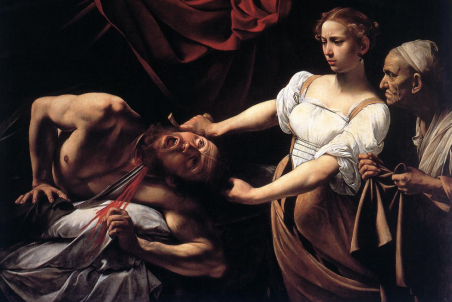 In the 1950s many of now celebrated Caravaggios had not yet been added to the artist'due south oeuvre. For case, Judith slaying Olofernes (Palazzo Barberini, Rome – illustrated here left), today i of Caravaggio'south most famous works, was only rediscovered by Longhi in 1950 and was added to the Milan exhibition only at the last moment; it didn't get in into the catalogue.
As a consequence of the newly developed involvement on the painter, between 1952 and 1993, viii more than paintings were added to Caravaggio's work. These attributions were first published in the Burlington.
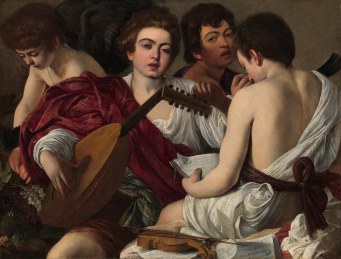
- The at present celebrated Musicians in the Metropolitan Museum of Art (New York, illustrated hither), was discovered past Mahon in 1952 and published in the Burlington's January upshot [8] as Una Musica, with a triumphant article of xx pages. Mahon, as proud as Sherlock Holmes, described the identification of the lost canvas through a 'tiny unprofessional photograph of a flick [that] he had seen in the collection of a individual amateur in an English language country house'. [9]
- In 1956, with the championship 'A late Caravaggio rediscovered', [10] Mahon identified as an original Caravaggio the painting Christ at Column, today in Musée des Beaux Arts, Rouen. The canvass was firstly discovered by Longhi in a private Swiss collection, and was included in the Milan exhibition as copy.
- 1974 was another significant twelvemonth for Caravaggio studies, marked by the exhibition in Palazzo Pitti in Florence, 'Caravaggio and the Caravaggesque' (Caravaggio e i Caravaggeschi). Its importance was recognised in the Burlington October 1974 issue. Nicolson
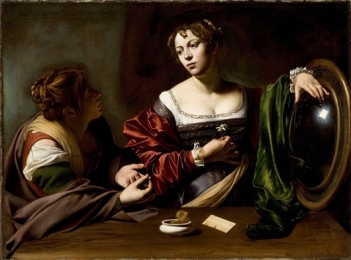 'due south editorial, the third devoted to the artist, commented extensively the Florentine exhibition and the popularity of the artist in the British isles. [11] In the same consequence, The conversion of the Magdalen, known also as 'The Detroit Conversion' orthe 'Alzaga Caravaggio' (illustrated here left), was newly attributed to the artist with a detailed article that covered all the aspects of the work. The painting'south iconography was investigated past Frederick Cummings, Curator of the Detroit Museum of Fine Arts. [12] A thorough technical analysis was undertaken and published by the museum'south conservators; whereas Luigi Spezzaferro explored the documentary findings around this picture. [13] Finally, its wider art historical implications were discussed by Luigi Salerno. [xiv]
- In the same result Gregori, in the article 'A New Painting and Some Observations on Caravaggio's Journey to Malta', attributed to Caravaggio the half length Portrait of Alof de Wignacourt, so on the Florentine art market. [15]
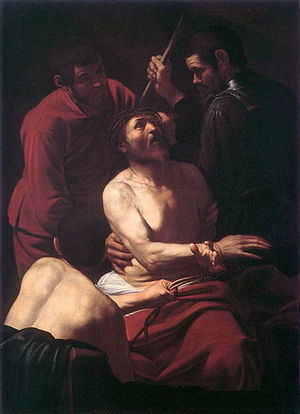
- Two years after, in October 1976, there followed another addendum to Caravaggio by Gregori, who attributed to the creative person the Cecconi Crowning with Thorns (Palazzo degli Alberti, Prato, illustrated hither right) when she 'reconsidered' the canvas later on its restoration.
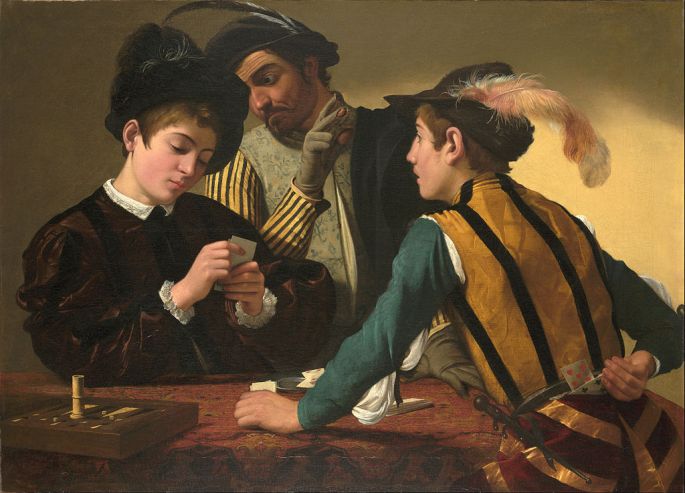
- In January 1988, Mahon announced his discovery of the original canvass of the Cardsharps with his article "Fresh Light on Caravaggio'south Primeval Period: His 'Cardsharps' Recovered'. [16] (the Cardsharps is illustrated above just after the offset paragraph of this blog). This article was followed past an appendix, which included a detailed technical report on the canvas by Christiansen. [17]
- In Jan 1990, Mahon, in one case again in collaboration with Christiansen, authenticated Wildenstein'due south, Singing 'Lute-Histrion', then on loan to the Metropolitan Museum in New York. [eighteen] Christiansen and so published his article 'Some Observations on the Relationship betwixt Caravaggio's Two Treatments of the 'Lute-Player', in the Burlington. [19]
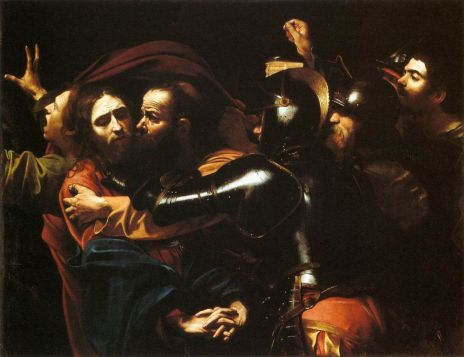
- In Nov 1993, Benedetti in collaboration with Francesca Cappelletti, attributed to Caravaggio The Taking of Christ (Dublin, National Gallery – illustrated here at the acme of the folio), defining it as 'a masterpiece rediscovered' and supplemented his article with 'the documentary show of the early on history' of the painting.
During the second half of the 20th century, so, the Burlington contributed much to the shaping of Caravaggio'south oeuvre as we know information technology today. The side by side post will compare manufactures on Caravaggio written in the beginning half of the century, and evidence how the Burlington contributors were then generally concerned with matters of style, and focused on the interpretation of Caravaggio's unique canvases rather than on questions of connoisseurship.
NK December 2016
[1] R. Spear, 'Caravaggiomania', Α rt in America, 98 (2010), pp. 116-118.
[2] J. Hess, 'The Chronology of the Contarelli Chapel', The Burlington Magazine, Vol.93, No.579, June 1951, pp.186-201.
[three] D. Mahon, 'Egregius in Urbe Pictor: Caravaggio Revised', The Burlington Magazine, Vol. 93, No.580, July 1951, pp. 222-235.
[4] D. Mahon, 'Caravaggio's Chronology Again', The Burlington Magazine, Vol. 93, No. 582, September 1951, pp. 286-292.
[5] O. Green and D. Mahon, 'Caravaggio'due south Death: A New Certificate', The Burlington Magazine, Vol. 93, No. 579, June 1951, pp. 202-204.
[6] Editorial, 'The showtime modern painter', The Burlington Mag, Vol. 93, No. 580, July 1951, p.211.
[7] D. Mahon, 'Caravaggio'south Chronology Once again', Vol. 93, No. 580, July 1951, p. 292.
[8] D. Mahon, 'Addenda to Caravaggio', The Burlington Magazine, Vol.94, No.586, January 1952, pp.2-23.
[nine] Ibid, p. 3.
[ten] D. Mahon, 'A Late Caravaggio Rediscovered', The Burlington Mag, Vol.98, No. 640, July 1956, pp.224-229.
[11] Editorial, 'Caravaggio and His Circle in the British Isles', The Burlington Magazine, Vol. 116, No. 119, October 1974, pp. 559-560.
[12] F. Cummings, 'Detroit's 'Conversion of the Magdalen' (the Alzaga Caravaggio) 1 and iii – 'Introduction' and 'Meaning', The Burlington Mag, Vol.116, No.859, October 1974, pp. 562-591. J. L. Greaves and Thou. Johnson, 2: 'New Findings on Caravaggio's Technique in the Detroit 'Magdalen',The Burlington Mag, Vol.116, No.859, October 1974, pp.564-591.
[xiii] Fifty. Spezzaferro,'Detroit'south 'Conversion of the Magdalen' (the Alzaga Caravaggio) 4 – The Documentary Findings: Ottavio Costa every bit a Patron of Caravaggio', The Burlington Mag, Vol. 116, No. 859, October 1974, pp. 570-591.
[14] L. Salerno, 'Detroit's 'Conversion of the Magdalen' (the Alzaga Caravaggio) five – The Art-Historical Implications of the Detroit 'Magdalen', The Burlington Mag, Vol. 116, No. 859, Oct 1974, pp. 565-593.
[15] G. Gregori, 'A New Painting and Some Observations on Caravaggio's Journey to Malta', The Burlington Magazine, Vol.116, No. 859, October 1974, pp. 592-603.
[16] D. Mahon, 'Fresh Light on Caravaggio's Earliest Catamenia: His 'Cardsharps' Recovered', The Burlington Magazine, Vol.130, No.1018, January 1988, pp.ten-25.
[17] Thousand. Christiansen, 'Appendix: Technical Report on 'The Cardsharps'', The Burlington Magazine, Vol.130, No. 1018, January 1988, pp. 26-27.
[xviii] D. Mahon,'The Singing 'Lute-Player' by Caravaggio from the Barberini Collection, Painted for Cardinal Del Monte', The Burlington Mag, Vol. 132, No.1042, Jan 1990, pp.4-23.
[19] K. Christiansen, 'Some Observations on the Relationship between Caravaggio'southward Two Treatments of the 'Lute-Player'', The Burlington Mag, Vol.132, No.1042, January 1990, pp.21-26.
Source: https://burlingtonindex.wordpress.com/2016/12/10/caravaggiomania-in-the-burlington-magazine-i-the-late-20th-century/

Enregistrer un commentaire for "Notable Works of Art Now on the Market Burlington Magazine 119"